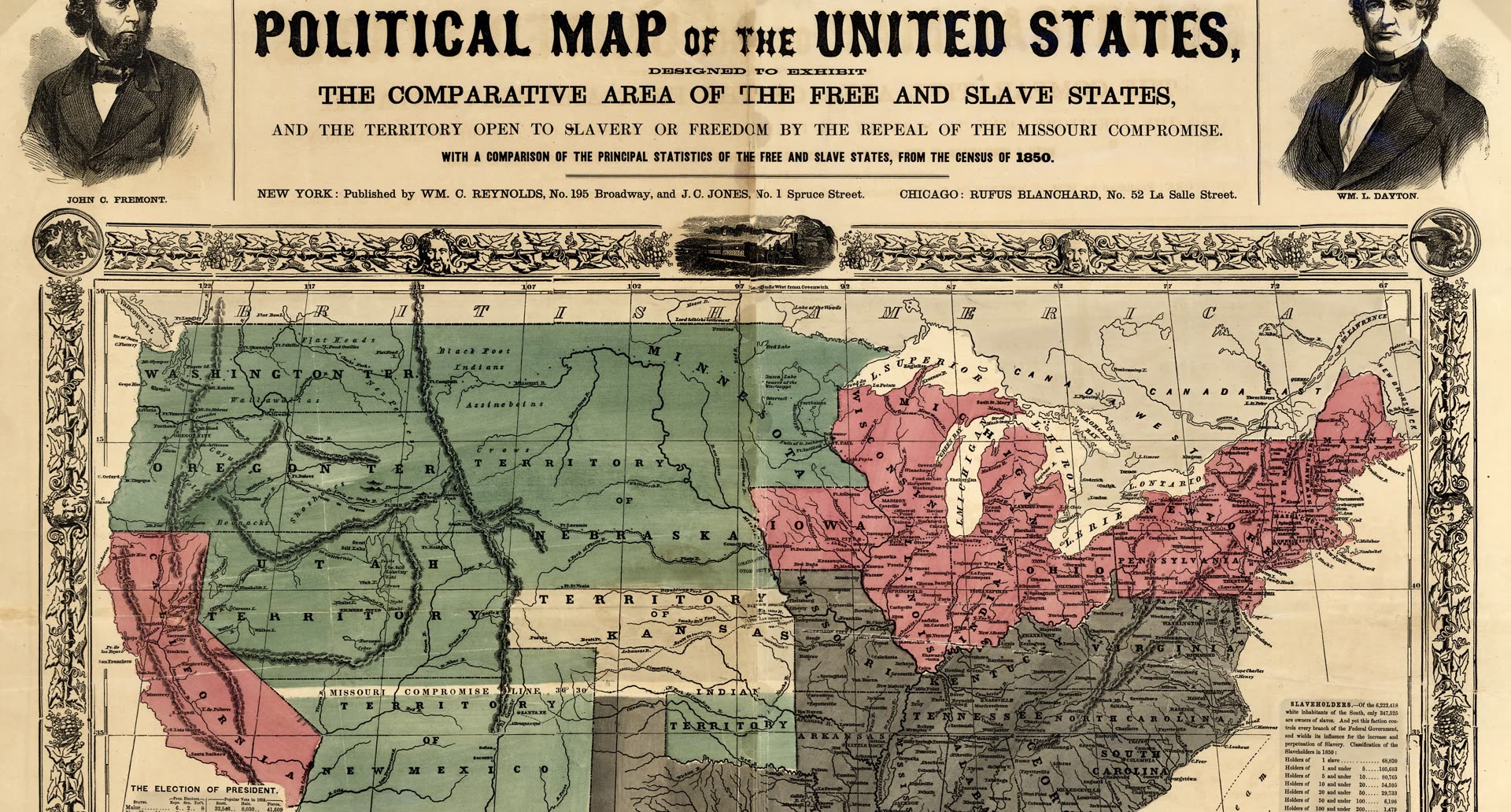
On the afternoon of July 12, 1893, a thirty-one-year-old history professor from Wisconsin named Frederick Jackson Turner stood in a hot lecture hall at the World's Columbian Exposition in Chicago and read a paper called "The Significance of the Frontier in American History." Attendance was thin. The paper was one of a long series scheduled that afternoon by the American Historical Association, and most of the delegates had wandered off to see the Ferris wheel or the electric lights or the reconstructed Viking ship. Buffalo Bill Cody's Wild West show was performing just outside the fairgrounds, drawing twenty thousand people a session. He had been refused a spot inside the Exposition and had responded by leasing the land across the street.
That juxtaposition is the whole story. Inside the fairgrounds, an academic was announcing that the frontier was dead. A few hundred yards away, an actor was making a fortune resurrecting it in front of the largest crowds of his career. Both men were describing the same country, at the same moment, and both were correct.

What actually happened in 1890
Two things happened in 1890 that would get tangled together for the next century. In the fall, the Superintendent of the Census published his report and noted that the frontier line could no longer be drawn on a map. On December 29, at Wounded Knee Creek in South Dakota, soldiers of the Seventh Cavalry killed roughly two hundred and fifty Lakota, most of them noncombatants, most of them unarmed, in what the army officially called a battle and everyone else eventually came to call a massacre.
The Census announcement was administrative. Wounded Knee was final. Between them, in the space of a few months, the United States declared and enforced the end of something. Whatever the frontier had been, it was closed now, on paper and in blood.
Americans noticed the paper closing much more than the actual one. The Wounded Knee dead were reported briefly and mostly forgotten. The Census report, which almost nobody had actually read, became the seed of a national obsession.
The country in the 1890s
To understand why the closing landed as hard as it did, you have to look at what else was happening. The 1890s were among the ugliest decades in American history.
The Panic of 1893 wiped out roughly a quarter of American railroads and thousands of banks. Unemployment ran above ten percent for four years. In the summer of 1894, Coxey's Army, a march of unemployed workers, walked from Ohio to Washington to demand federal jobs and was broken up on the Capitol lawn. That same summer, federal troops crushed the Pullman strike in Chicago, killing thirty. Two years earlier, Pinkerton agents had killed workers at Homestead. Six years before that, someone had thrown a bomb at police in Haymarket Square. The labor question, as it was called, was not theoretical. It looked like the beginning of a class war.
Immigration was at record levels, and the composition was shifting. The new arrivals were mostly from southern and eastern Europe, mostly Catholic or Jewish, mostly poor, and mostly landing in cities that were already unable to house them. Chicago doubled in population between 1880 and 1900. The Lower East Side of Manhattan became one of the densest human settlements on earth. Nativist movements grew accordingly. The American Protective Association, founded in 1887, had two and a half million members by 1896.
Reconstruction had ended in 1877 and its promises were being systematically dismantled. Plessy v. Ferguson was decided in 1896. Lynchings peaked in the early 1890s, averaging more than a hundred a year. The populist movement in the South and Midwest was gathering strength and would nearly capture the presidency in 1896.
Something was clearly ending. What people disagreed about was what.
The safety valve
The frontier had done specific ideological work in American thinking for at least half a century before Turner made it academic. The theory, associated with everyone from Thomas Jefferson to Horace Greeley, was that the availability of free western land acted as a safety valve for eastern discontent. A factory worker who did not like his wages could, in principle, go west and become a farmer. A city that could not absorb its immigrants could, in principle, send them somewhere else. Democracy remained possible because there was always more room.
Historians have since demonstrated that the safety valve mostly did not work in practice. Very few unemployed factory workers actually became western farmers. The costs of moving and starting a homestead were beyond the reach of the people who most needed the escape. But the belief in the safety valve was politically useful whether or not it was empirically true. It let policymakers avoid harder questions about wages, tenure, ownership, and the concentration of wealth. As long as the West existed, American inequality could be treated as temporary.
Take that away, and the questions had to be faced. If there was no more room, then the tensions in the cities and the mines and the factories were not going to resolve themselves by migration. They were going to have to resolve some other way.
Turner did not invent this anxiety. He put an academic frame around something that political and business elites had already begun to feel in their stomachs.
The strenuous response
The responses to the perceived closing were varied and mostly overlapping. Theodore Roosevelt is the cleanest example, because he combined most of them in one biography.
Roosevelt's answer to the closing of the frontier was that Americans had to find new frontiers or invent them. He hunted in the Dakotas, wrote a four-volume history called The Winning of the West, and preached what he called the strenuous life, which held that individuals and nations both grew soft and decadent without physical struggle. Then he built the Rough Riders out of a mix of Ivy Leaguers and actual cowboys, self-consciously fusing the eastern gentleman and the western fighter into a single new American type. And when he found himself in a position to help start a war with Spain in 1898, he took it.
The empire abroad was, among other things, a response to the closing of the empire at home. If the internal frontier was gone, the country would find external ones. The Philippines, Puerto Rico, Cuba, and Hawaii were not accidents. They were the psychological continuation of the westward push, minus the pretense that anyone was going there to homestead.
Muscular Christianity, the Boy Scouts, the founding of the NCAA, the sudden vogue for football, the physical culture movements of Bernarr Macfadden and Eugen Sandow, and the eugenics movement all rose in roughly the same window. Each of them, in its own way, was an answer to the fear that Anglo-Saxon Americans were becoming too soft, too urban, too foreign, or too few. The frontier had allegedly kept Americans hard. Now the country needed to find other ways.
The invention of the West
At the same time, and often through the same people, the West was being turned into a product.
Buffalo Bill's Wild West show ran from 1883 until 1913. At its peak it employed hundreds of performers, including for a time Sitting Bull, and toured Europe as well as the United States. It featured mock stagecoach robberies, mock Indian attacks, sharpshooting exhibitions by Annie Oakley, and reenactments of specific historical events like Custer's Last Stand. Cody, who had been a real scout and a real buffalo hunter, was inventing the visual language of the western at exactly the moment the actual West was ceasing to exist in the form he was depicting.
The dime novel industry had been producing western stories since the 1860s, but the 1890s saw the emergence of the more literary form. Owen Wister's The Virginian was published in 1902 and became the template for essentially every subsequent western novel and film. Frederic Remington's paintings of cowboys and cavalry began appearing in mass-market magazines in the late 1880s. Charles Russell was working the same territory from Montana. Roosevelt was writing about ranch life for eastern readers. The genre we now call "the western" was being assembled in real time, largely by people who had spent some actual time in the West and had every reason to know they were mythologizing it.
That is what makes the moment strange. The mythmaking accelerated as the reality receded. The West became most vivid in American imagination in the exact decades when it stopped existing as a distinct place. Dime novels sold better after the cattle drives ended. Paintings became iconic after the open range was fenced. Buffalo Bill made his fortune performing a version of the West that his audiences were mostly too young to have known and that his own middle age had already outlived.
Nostalgia is what you feel about something that is gone. The 1890s were the decade in which Americans learned to feel it, at industrial scale, about their own country.
Preservation as inheritance
The other response, quieter but more permanent, was preservation. Yellowstone had been established in 1872, before the closing became a topic, but the real wave of national parks came after. Yosemite in 1890, Sequoia and General Grant the same year, Mount Rainier in 1899, Crater Lake in 1902, Mesa Verde in 1906. The Antiquities Act, which gave the president unilateral authority to declare national monuments, was signed by Roosevelt in 1906.
John Muir understood exactly what was happening. He wrote in the 1890s that Americans were finally realizing that the wilderness they had spent three centuries conquering was almost gone, and that the impulse to conquer was giving way, at least in a few places, to the impulse to keep. Preservation was the closing frontier being converted into an inheritance. The mountains that had once been things to cross would now be things to visit.
That impulse coexisted, uncomfortably, with everything else the country was doing. Yosemite was set aside a few months before Wounded Knee. The national parks were often created by displacing the same Native peoples whose removal had made the frontier "closed" in the first place. The America that mourned the loss of wildness was also, at the same moment, finishing the work of eliminating the humans who had lived in it. The mourning did not slow the work.
What was actually being mourned
The obsession with the closing was not really about acreage. The country had plenty of land in 1890, and plenty of it was still very lightly settled. The Census Bureau's threshold of two people per square mile was, as thresholds go, extremely modest. Vast regions of Nevada, Wyoming, and Montana are below it now, in 2026.
What was being mourned was the ideological function the frontier had performed. As long as there was a frontier, America could believe that its problems were ones of expansion, of movement, of getting to the next unoccupied place. Without a frontier, the country had to face itself as a settled society, with fixed borders and internal contradictions that were not going to resolve themselves geographically. The wealth gap, the labor question, the race question, the immigrant question, the urban question: all of them had to be dealt with in place. There was no more "somewhere else" to send the problem.
Americans have never really made peace with that. The frontier keeps getting reinvented. Kennedy named a program after it. Silicon Valley took the word for itself. Space became a frontier, then artificial intelligence. Every generation seems to need to locate one somewhere, because the alternative is to admit that the country is a finite place, with finite room, arguing with itself about how to share what it has.
The obsession with 1890 was the first sign that this admission was coming and that Americans did not want to make it. A hundred and thirty-six years later, we still mostly don't.