In 1850, baseball was one member of a loose family of bat-and-ball games played under local names and local rules. Fifty years later, professional clubs occupied enclosed grounds, newspapers printed box scores, and fans argued over pennant races from Boston to St. Louis. People had begun calling baseball the national pastime decades before 1900. The title did not come from a single inventor or one decisive game. It grew out of a long process in which players standardized the rules, clubs turned local loyalty into paying attendance, and promoters built leagues that could survive repeated failures.
Baseball's rise also exposed a harder truth about organized sport in the United States. The same institutions that made regular schedules and national competition possible gave owners greater authority over players and helped exclude Black Americans from leading white leagues. By the end of the century, baseball could plausibly present itself as a shared national game, but its version of the nation was sharply limited.
A Game Without a Single Inventor
Baseball did not spring fully formed from Abner Doubleday at Cooperstown. That familiar story was promoted in the early twentieth century and has not survived historical scrutiny. Americans had played several related games, including town ball and forms of base ball, well before the period when Doubleday supposedly invented the sport. What happened in the 1840s and 1850s was less dramatic and more important: clubs around New York began turning one version of the game into a common code.
The New York Knickerbockers adopted a written set of rules in 1845. Those rules did not create modern baseball by themselves, and later clubs altered them considerably. They did establish recognizable features, including foul territory, three outs to a side, and the practice of retiring a runner by tagging rather than striking him with a thrown ball.
The decisive step toward uniformity came through cooperation among clubs. At a convention in 1857, delegates approved nine players to a side, nine innings per game, and ninety feet between bases. The National Association of Base Ball Players, organized that year, gave clubs a governing body through which they could settle rules and arrange competition. Standardization allowed a club from Brooklyn to meet one from another city without spending the first hour arguing over how the game would be played.
The early clubs were voluntary associations as much as athletic teams. Their members were often clerks, artisans, shopkeepers, and businessmen who paid dues and treated membership as a mark of fellowship and respectability. After a match, opponents might dine together. Yet the competitive side was never far away. Strong clubs attracted spectators, newspapers reported prominent contests, and winning brought attention to a neighborhood or city. The social club was becoming a public attraction.
War, Mobility, and a Wider Audience
Baseball was spreading before the Civil War, particularly through the Northeast and parts of the Midwest. The war accelerated contact among men from different regions, and soldiers played when duties and conditions allowed. Wartime games appeared in newspaper reports, while returning servicemen carried knowledge of the New York game home. It would be too simple to say that soldiers alone nationalized baseball. Migration, urban growth, established club networks, and the press were already doing much of that work. The war added force to an expansion already underway.
Baseball also suited the physical geography of a growing country. A team required open ground and modest equipment. Railroad connections made travel between cities easier, while the telegraph and expanding newspaper circulation helped results move faster than the clubs themselves. Readers could follow leading teams even when they could not attend. The box score, developed during the 1850s and refined afterward, compressed a game into a form that a newspaper could print and a fan could study.
This circulation of scores and stories helped turn clubs into civic representatives. Brooklyn's Atlantics, Philadelphia's Athletics, and other strong teams carried the names and reputations of their communities. Their games offered a clear result and a common subject for conversation. Baseball did not erase local rivalry. It grew by organizing that rivalry.
By the early 1860s, writers were already using the phrase “national pastime.” The description was promotional, but it was not empty. Large crowds attended important matches even during the war. In 1862, with Union forces near Richmond, The New York Times reported on contests involving leading clubs from Brooklyn and Philadelphia. The National Association continued to debate rules, and in 1864 it required fair balls to be caught on the fly for an out rather than allowing a catch on the first bounce. The game was becoming faster, harder, and more attractive to watch.
From Club Fellowship to Paid Work
Competition placed pressure on the amateur ideal. Clubs wanted the best players, and some found jobs or payments for talented men while continuing to call themselves amateur organizations. Enclosed grounds made it possible to charge admission. Gate money could pay for travel, equipment, and eventually wages. Once spectators paid to see a winning team, club officers had a reason to recruit skill wherever they could find it.
The Cincinnati Red Stockings made the change public in 1869. Led by Harry Wright, Cincinnati fielded the first openly salaried professional nine. The club toured widely, traveled as far as San Francisco, and went undefeated against National Association opponents that year. Its success joined athletic excellence to promotion, commercial income, and civic pride. Other clubs had paid players before Cincinnati, often quietly. The Red Stockings mattered because they admitted what the sport was becoming.
Professional baseball remained financially unstable. The National Association of Professional Base Ball Players began play in 1871, but weak central authority, uneven schedules, and failing clubs damaged the league. Owners could not count on every member to finish a season. Players changed teams frequently, and accusations of gambling and fixed games threatened public trust.
William Hulbert and other club officials responded by forming the National League in 1876. The new organization placed more power in the hands of club owners. It required scheduled games to be played, claimed authority to discipline clubs and players, and selected members partly according to the size and financial promise of their cities. This structure brought greater order, though stability came slowly. Franchises still folded, rival leagues still appeared, and disputes over money continued.
The National League's reserve system showed who paid for that stability. In 1879, owners agreed that each club could reserve five players whom other league clubs would not sign. The rule later expanded. Owners defended it as protection against bidding wars and sudden roster changes. For players, it reduced freedom to seek a better offer. The Brotherhood of Professional Base Ball Players challenged owner control, and in 1890 it supported the short-lived Players' League. The revolt failed after one season, but it made the conflict plain: professional baseball depended on skilled labor while denying players much control over where they worked.
Selling the Game to the City
No single business model won immediately. The National League generally charged fifty cents and sought patrons whom its leaders considered respectable. The rival American Association, founded for the 1882 season, often charged twenty-five cents, allowed Sunday games where local law permitted them, and sold beer at some parks. Critics called it the “Beer and Whiskey League.” Its policies brought in working people who labored six days a week and could attend most easily on Sunday.
Arguments over admission prices, alcohol, gambling, and Sabbath observance were arguments over the game's audience. Club owners wanted full grounds, but they disagreed about which customers would give baseball social standing and reliable income. Fans made their own choices. Thousands attended Sunday games despite protests and arrests in cities that enforced laws against them. Holiday doubleheaders drew workers who otherwise had few chances to see professional play.
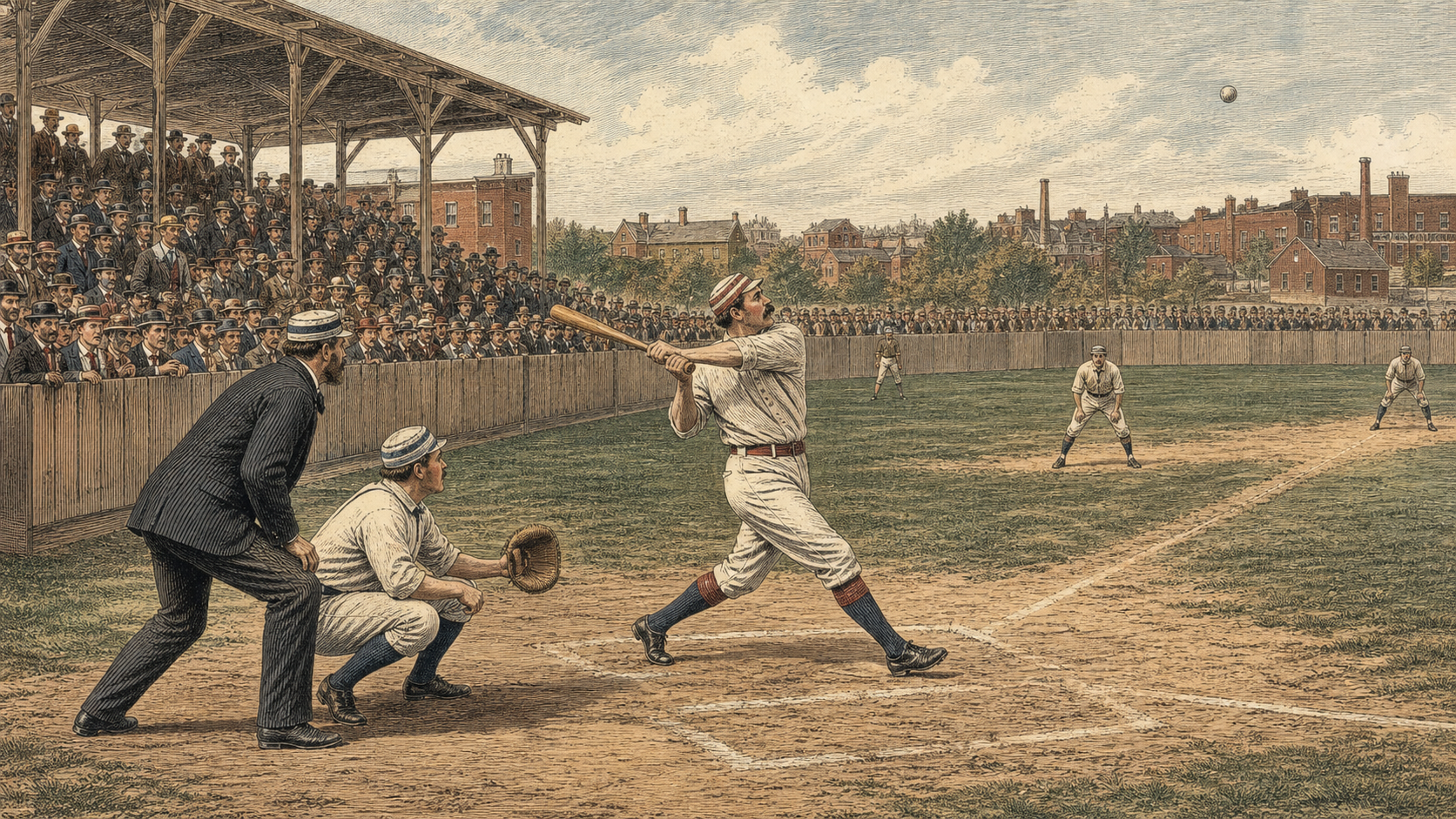
The ballpark became a commercial public space. Spectators bought admission and judged players whose names they knew from the papers. They heckled umpires, kept score, wagered, and returned for the next series. Women attended professional games too, sometimes in sections or on days promoted as more respectable, though newspaper coverage often treated their presence as a comment on manners rather than an interest in sport. Women also played baseball in colleges and on organized teams, but the professional game's leaders marketed their leagues chiefly as a male institution.
Equipment, rules, and tactics continued to change. Fielders adopted gloves despite early ridicule. Pitching restrictions loosened, and pitchers gradually moved from underhand delivery toward the overhand motion legalized in the 1880s. Catchers came closer to the plate as masks, chest protectors, and better gloves reduced some of the danger. Called balls and strikes gave pitchers and batters firmer limits. By 1900, a fan from the 1850s would have recognized the diamond but noticed a quicker and more specialized contest.
The Color Line
Baseball's claim to represent the country was compromised from the beginning by racial discrimination. Black Americans formed clubs during the 1860s, including Philadelphia's Pythians, but the National Association of Base Ball Players moved in 1867 to exclude Black clubs. Its officials chose racial separation rather than risk disagreement among white members.
The boundary was not yet complete. Black players found places on some integrated professional and minor-league teams. Bud Fowler played professionally from the late 1870s into the 1890s. Moses Fleetwood Walker caught for Toledo in the major American Association in 1884. Frank Grant, George Stovey, and other Black players earned notice for their ability in the 1880s.
White players and officials then closed those openings. Cap Anson, the prominent Chicago player-manager, repeatedly objected to taking the field against Black players. He did not establish segregation single-handedly, but his conduct supported a broader campaign already present in the sport. In July 1887, International League owners voted to approve no further contracts with Black players. Other leagues followed through written rules or common practice. By the early 1890s, Black players had been driven out of the leading white professional circuits.
Black baseball did not disappear. Independent clubs such as the Cuban Giants traveled and played paying crowds, while efforts to establish Black leagues continued despite limited capital and hostile treatment. Organized baseball's color line divided the professional game just as it was gaining national authority. The pastime was popular enough to cross regions and classes, yet its most powerful institutions enforced the racial order of the period.
A National Pastime by 1900
By the end of the nineteenth century, baseball had acquired most of the foundations that would support its twentieth-century power: shared rules, professional players, scheduled leagues, enclosed parks, a large sporting press, recognizable stars, and loyal city audiences. Its language had entered everyday speech. Its season followed the warmer months, and its daily results gave readers a continuing story built from separate games.
Baseball became America's pastime because it joined local attachment to national comparison. A fan could care intensely about one city while following the same standings and rules as fans hundreds of miles away. Railroads carried teams, newspapers carried their records, and leagues gave their meetings a regular structure. None of this was secure or prearranged. Clubs failed, leagues fought, players rebelled, and promoters repeatedly adjusted the game to keep spectators coming.
The title “national pastime” should therefore be read as both description and sales pitch. By 1900, baseball had reached a national audience and developed institutions strong enough to claim permanence. Those institutions also decided who could play, who controlled the money, and which crowds were desirable. Baseball's rise tells us how a game became a business and a shared habit. It also shows that a national culture can become widely held while remaining unequal in its terms.
Sources and Further Reading
- Library of Congress, “New Fundamental Rules”
- Library of Congress, “Drawing the Color Line: 1860s to 1890s”
- National Baseball Hall of Fame, “Baseball Came of Age During the Civil War”
- National Baseball Hall of Fame, “Pro Baseball Began in Cincinnati in 1869”
- Society for American Baseball Research, “William Hulbert and the Birth of the National League”
- Society for American Baseball Research, “Before Jackie: Baseball's Color Line”
- Society for American Baseball Research, “Holiday Doubleheaders”