John Muir and the Preservation of National Parks
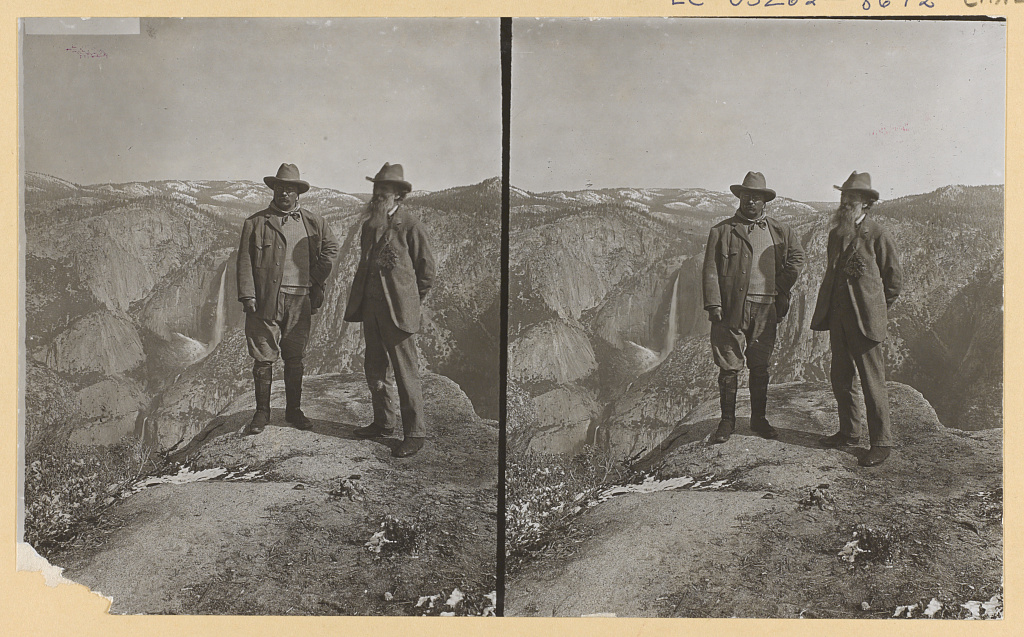
Theodore Roosevelt and John Muir at Glacier Point, Yosemite, 1903. Library of Congress. The image has no known restrictions on publication. ([The Library of Congress][1])
John Muir did not invent the American national park, but he helped give the idea its moral force.
Before Muir, many Americans saw mountains, forests, and valleys mainly as resources. Timber could be cut. Rivers could be dammed. Meadows could be grazed. Land had value when it could be turned into something useful. Muir argued for a different kind of value: that wild places mattered even when they were not being used, improved, or sold.
That belief shaped the preservation movement and helped define what national parks would become.
A Life Changed by the Mountains
John Muir was born in Scotland in 1838 and later immigrated with his family to the United States. As a young man, he studied botany, geology, and chemistry, but much of his real education came from walking. The National Park Service notes that Muir eventually left formal schooling for what he called “the University of the Wilderness,” arriving in the San Francisco area in 1868 and soon falling in love with the Sierra Nevada. ([National Park Service][2])
Muir wandered through the mountains with a plant press and notebook. He studied glaciers, trees, flowers, animals, weather, and rock. But he was not only collecting facts. He was forming a way of seeing.
To Muir, nature was not scenery arranged for human enjoyment. It was alive in its own right. The National Park Service describes his view plainly: Muir came to believe that all life had inherent significance and that humans were not greater than other forms of life. ([National Park Service][2])
That idea sounds familiar now. In Muir’s time, it was a challenge to the habits of a young, expanding nation.
Yosemite and the Argument for Preservation
Yosemite became the center of Muir’s life and work. He saw the valley and surrounding high country as more than a beautiful destination. He saw them as places that could be damaged, and quickly, by grazing, logging, and commercial development.
Muir wrote essays and books that made the Sierra Nevada vivid to readers who might never stand there themselves. His writing helped turn public affection into political pressure. Congress established Yosemite National Park in 1890, protecting large areas of forest and mountain land from further destruction. ([National Park Service][2])
This was one of Muir’s great gifts to the preservation movement. He made the case that beauty was not a luxury. A valley, a grove of sequoias, or a granite dome did not need to justify itself by becoming timber, pasture, or real estate.
It could simply remain.
The Sierra Club and Organized Preservation
Muir was often happiest alone in the mountains, but he learned that solitude could not protect a forest. Preservation needed organization.
In 1892, Muir and others founded the Sierra Club. He became its first president, and the club worked to teach people about wild places and the threats facing them. ([National Park Service][2]) Teaching American History notes that Muir’s magazine articles had already helped support the 1890 act creating Yosemite National Park, and that he was unanimously named president of the new organization. ([Teaching American History][3])
The Sierra Club gave preservation a public voice. It brought together scientists, hikers, writers, lawyers, and citizens who believed that the mountains needed defenders. That model still matters. National parks are not protected once and then left alone forever. They have to be defended again and again, in courts, legislatures, newspapers, budgets, and public opinion.
Muir understood that.
Muir, Roosevelt, and the Power of a Campfire
One of the most famous moments in American conservation came in 1903, when President Theodore Roosevelt visited Yosemite with Muir.
The trip was not a ceremonial tour. Muir guided Roosevelt through Mariposa Grove, Sentinel Dome, Glacier Point, Yosemite Valley, and other parts of the park. The two men camped for three nights, including one night near Sentinel Dome during a snowstorm. ([National Park Service][4])
Muir used the time well. Around the campfire, he pressed Roosevelt on forest preservation and argued that Yosemite Valley and Mariposa Grove should be returned from state control to federal protection as part of Yosemite National Park. Their discussions helped lead to Roosevelt signing the Yosemite Recession Bill in 1906, which brought those lands under federal protection. ([National Park Service][4])
Roosevelt’s conservation record was large by any measure. During his presidency, he created five national parks, 18 national monuments, 55 national bird sanctuaries and wildlife refuges, and 150 national forests. ([National Park Service][4]) Muir did not do that work alone, of course. But his influence on Roosevelt mattered.
The image of the two men standing at Glacier Point has lasted because it captures something real: preservation sometimes depends on putting the right person in the right place and letting the place speak.
Preservation Versus Use
Muir’s vision was preservationist. He believed some places should be protected from development because they had value beyond human use.
That put him at odds with a different conservation tradition, often associated with figures like Gifford Pinchot, who emphasized managed use of natural resources. In simple terms, Pinchot wanted forests managed wisely for public benefit. Muir wanted certain wild places left alone.
Both views shaped American public land policy. But national parks owe much of their spirit to Muir’s side of the argument. Parks were not meant to be ordinary public lands. They were meant to be places where extraction stopped, or at least where it was supposed to stop.
The tension never disappeared. Roads, hotels, dams, crowds, fire policy, tribal rights, wildlife management, and climate change have all tested the meaning of preservation. Muir’s work did not settle those questions. It forced the country to ask them.
The Loss of Hetch Hetchy
Muir’s greatest defeat came late in his life, in the fight over Hetch Hetchy Valley inside Yosemite National Park.
San Francisco wanted to dam the valley to create a reliable water supply. Muir and the Sierra Club opposed the project, arguing that a national park valley should not be flooded for municipal use. The Sierra Club officially supported preserving Hetch Hetchy after a member poll in 1910, but Congress approved the dam in 1913. ([National Park Service][5])
The loss hurt Muir deeply. The National Park Service describes Hetch Hetchy as the biggest fight Muir and the Sierra Club faced, and notes that after Congress approved the dam, Muir retreated from politics and spent his last years writing and with his family. He died in December 1914. ([National Park Service][2])
Hetch Hetchy showed that national park status alone was not enough. A park still needed laws, public support, political will, and a shared belief that some lines should not be crossed.
A More Honest Legacy
Muir’s legacy is important, but it should not be treated as spotless.
The preservation movement often described places like Yosemite as untouched wilderness, even though Indigenous people had lived in, shaped, and cared for those lands for generations. Modern readers also have to reckon with Muir’s own harmful descriptions of Black and Indigenous people, which the Sierra Club and others have publicly addressed. ([PBS][6])
This does not erase Muir’s work. It makes the history more complete. The national park idea preserved extraordinary places, but it also often ignored or displaced the people already connected to those places. Any honest discussion of preservation has to hold both truths at once.
The parks are beautiful. The history is complicated.
Why Muir Still Matters
John Muir mattered because he changed what people thought wild land was for.
He argued that mountains and forests were not waiting rooms for industry. He wrote with enough force to move readers, helped organize preservation into public action, and made the case directly to people with power. Yosemite, Sequoia, and the wider national park movement all bear the mark of his work.
But Muir’s larger importance may be simpler than that. He helped Americans see restraint as a public good. He believed there was wisdom in leaving some places uncut, undammed, and unspoiled.
That idea remains difficult. It asks people to accept limits. It asks governments to protect what cannot easily be priced. It asks visitors to love a place without using it up.
National parks are still one of the clearest expressions of that belief. They are not perfect. They never have been. But at their best, they preserve something rare: the chance for a country to say that some places are worth more standing than spent.
--- [1]: https://www.loc.gov/pictures/item/93503130/ "
\[Theodore Roosevelt and John Muir on Glacier Point, Yosemite Valley, California, in 1903]
" [2]: https://www.nps.gov/articles/john-muir.htm "John Muir (U.S. National Park Service)" [3]: https://teachingamericanhistory.org/john-muir-founds-the-sierra-club/?utm_source=chatgpt.com "John Muir Founds the Sierra Club" [4]: https://www.nps.gov/jomu/learn/historyculture/john-muir-and-president-roosevelt.htm?pubDate=20250213&utm=syndication "John Muir and President Roosevelt - John Muir National Historic Site (U.S. National Park Service)" [5]: https://www.nps.gov/jomu/learn/historyculture/the-hetch-hetchy-timeline.htm?ref=walkingaway.us&utm_source=chatgpt.com "The Hetch Hetchy Timeline - John Muir National Historic ..." [6]: https://www.pbs.org/newshour/nation/sierra-club-calls-out-founder-john-muir-for-racist-views?utm_source=chatgpt.com "Sierra Club calls out founder John Muir for racist views"