Animosity, Division and Hatred in Civil War America - Part 2
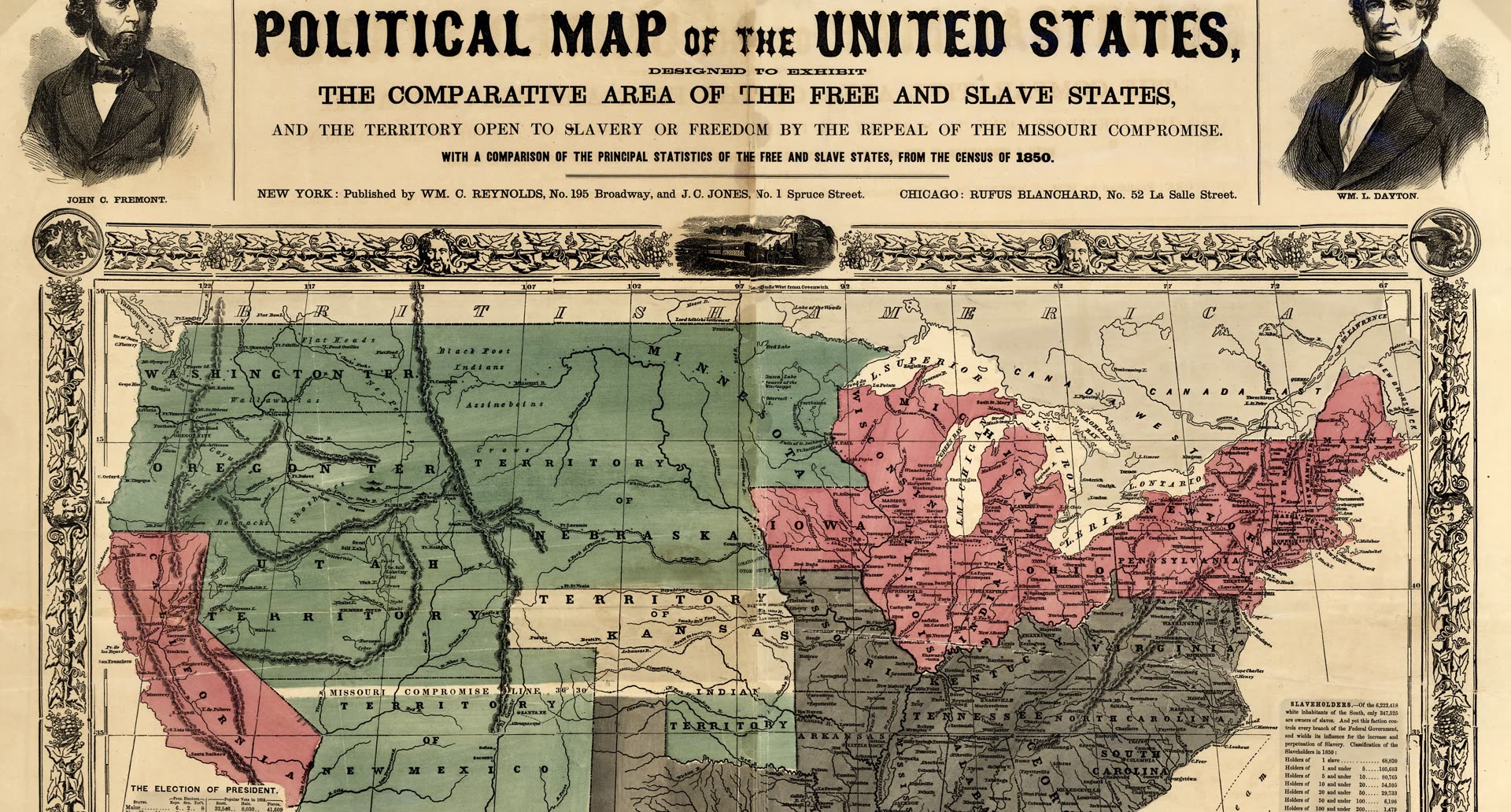
The animosity and division present in both Missouri and Kansas, prior to and during the Civil War, that led to guerrilla warfare in both states was a representation of the divide gripping the entire nation, pushing it towards inevitable war.
Author and historian Bruce Nichols presents his argument that there five motivations for men to take up arms against their fellow countrymen, neighbors and even family. These reasons not only account for the guerrilla fighting on the western border, but as well as the rest of the nation. Along the border of Kansas and Missouri, however, there were few large-scale battles involving organized Union and Confederate troops, but the reasons for fighting were the same. Most of the fighting took place in unassuming places with no planning or strategy; tempers flared and bullets began to fly. The first reason is that many fought out of bitterness. Union General John M. Scofield claimed that …the bitter feeling between the border people, which feeling is the result of old feuds, and involves very little, if at all, the question of Union or disunion.[1] Many of those in Kansas and Missouri were at constant struggle with each other over the issues of slavery and the expansion of the nation. This was no different than that of the other southern states. Missourians felt that they or their friends and relatives, had been done wrong, and were bitter over the idea of being shielded behind the Federal government.
Guerrilla Samuel S. Hildebrand explained that,
The necessity that was forced upon me to act the part I did during the reign of terror in Missouri is all that I regret… it has caused my kind and indulgent mother to go down into her grave sorrowing; it has robbed me of three affectionate brothers who were blatantly murdered in their own innocent blood; it has reduced me and my family to absolute want and suffering, and has left us without a home, and I might also say, without a country.[2]
Southerners felt the same experiences. The late Shelby Foote explains in the Ken Burn's documentary "The Civil War" how upon capture, a Union soldier asks one of the Confederate men why they were even fighting this war. His response is an echo of the border conflicts in Missouri and Kansas -- I'm fighting because you're down here.[3] Vengeance and one's position for or against slavery was one of the motivations that created a bitterness between the nation and its people and caused them to take up arms against each other. With the years of violent murder and blood soaking the soil of the Kansas Missouri border prior to Ft Sumter, the admittance of Kansas as a free State fueled the quest for purging the nation of slavery, but also, to punish Missouri for what Kansans believed were atrocities posed against them. Kansans envied the fertile and provisional lands along the border in Missouri and because of a drought between 1859 and 1860, found the eve of Civil War a perfect catalyst to cross the border and satisfy both their vengeance and covetousness.[4]
Anger compelled many men to take up arms and fight against each other. For southerners, President Lincoln's call for volunteers to suppress the southern rebellion was a direct affront to them; that their own government would, by force, subject them against their will, the extremism of the abolitionists, sensational southern press and harsh tactics such as the draft, impressing private property for military use and enforcement of civil law.[5] From a Northern perspective, the people who were against secession viewed the southerners as traitors. It angered them that southerners had the audacity to challenge the government. A young Philadelphia printer echoed the rest of the pro-Union sentiment; This contest is not North against South…It is government against anarchy, law against disorder.[6] But unfortunately, this disorder and lawlessness was perpetrated by both Union and pro-southern officials and citizens. Mrs. Martha F. Horne lived in Cass county Missouri and explained how four of her slaves had run off in the night taking horses and provisions after her husband had gone off to war in 1862. She was left behind to face Jayhawkers, who took what little they had left that had not already been taken by the Redlegs or Union militia, including the negroes, horses, wagons, supplies and all. Upon arriving in Lawrence Kansas, she was informed that all of those supplies were robbed by Redleg's and the Negroes were left to root hog, or die.[7]
Hope was another factor for both the northerners and southerners, and both sides of the equation viewed their cause as the superior cause. Southerners clearly felt they were fighting an invading force. They were also fighting for their God given and Constitutional right to their property; slaves. Northerners on the other hand, truly believed that they were fighting to save the Union and that in doing so, and possibly sacrificing themselves, the experiment started by the Founding Fathers would continue and not be in vain. There were abolitionists, however, who fought to end slavery, and while they were not in the majority, they played an instrumental role in perceptions of the division in the country in regards to slavery. Many of these men, such as Daniel Anthony and George Henry Hoyt drew the ire of Union men simply with their unrelenting abolitionist rhetoric. But these men would eventually take part in a very violent point in the war in Missouri during the depopulation of border counties in Missouri. General Order No. 11 issued by Union General Thomas Ewing Jr. was enforced by the Red Legs, scouts sanctioned by the Union Army, under the command of Hoyt who resolutely, inflexibly, and at all times, under all circumstances, fight slavery.[8] In line with the concept of hope, patriotism was another example. The hope and belief in something bigger than themselves. The French call the initial impulse to fight rage militaire -- a patriotic furor that overcomes people at a time of national crisis.[9]
Desperation, especially in Missouri and Kansas, was a huge factor. Even before the first shot rang out at Ft. Sumter, regular, everyday citizens, who quite honestly preferred to just stay out of the whole mess of politics and remain neutral found themselves without a choice. When Lincoln made his call for volunteers it wasn't just to bolster the Union Army, it was to weed out the wheat from the chaff. Men who did not enlist in either army found themselves harassed to the point of death by both Union and Confederate Home Guards. The late historian Michael Fellmen wrote that As the war evolved, neither guerrillas nor Unionists permitted neutralism, seeing it as a service, however meekly given, to the enemy.[10]
The final motivation that Nichols provides is excitement. Young men went off to war and viewed that their fighting would bring them personal glory. Down in Arkansas, Henry Crawford and five others decided that the excitement of the bushwhacking there suited [us] finely…[11] They dressed and acted as bushwhackers and in the process of completely fooling everyone, in the process learning of guerrilla camps and leaders whereabouts, finally after listening to a guerrilla leader tell his stories of his acts against Federal troops, they shot the man in the head and headed back north.[12] However, in contrast, General William Tecumseh Sherman admonished those who would fight for excitement at a speech he gave in Columbus, Ohio on August 11, 1880 to fellow veterans of the war;
There is many a boy here today who looks on war as all glory, but, boys, it is all hell. You can bear this warning voice to generations yet to come. I look upon war with horror, but if it has to come, I am there.[13]
In Missouri, fighting out of excitement found itself confronted with a less patriotic overtone, but nonetheless violent and merciless as those fighting against them. Some of these young men, who rode with guerrilla bands initially out of excitement or for seeking revenge, became neurotic and criminal. Richard Brownlee explains that the irresponsible and undisciplined nature of guerrilla service naturally attracted the worst element of border society as it gave opportunity for robbery and unwarranted cruelty not present in regular military duty.[13] As a member of Quantrill's Raiders, Harrison Trow recounts that, As strange as it may seem the fascination of fighting under the black flag…attracted a number of young men to the various guerrilla bands.[15]
The Civil War brought out many sides to a vast and varied people. Some men marched off and joined regular military units. Teenagers gripped by adventure and glory followed as well. Some were forced to fight, and even women disguised themselves as men and went off to fight. The struggles in Missouri and Kansas and the reasons people went off to fight were no different, they only came to the breaking point sooner than the rest of the nation. Nevertheless, all the reasons men fought as guerrillas were very much at the heart of why the rest of the nation marched off to war in 1861. Most of the guerrilla fighters did so as a form of nationalism. They usually did not have slaves or care about the exporting of cotton, but they did feel bonded to their home state, more so than the Union soldiers, who clearly held a stronger affinity to the United States as a whole. This went side by side with their counterparts in the southern states who also choose state over the Union. Ultimately, it was, on both sides, a struggle for power.[16]
Southerners as well as guerrillas felt they were the living proof of the legacy of the American Revolution and held to the ideal that would buckle on the armor of our patriotic sires.[17] Those men rarely fought in organized units and guerrilla tactics is one of the reasons they were able to defeat a more organized and powerful British army.[18] Northerners, however, viewed this nationalistic pride in terms of the entire Union, and that by the actions of the South they were rendering the great American experiment a failure. For the people in Missouri and Kansas, there existed a very fine line between patriotism and revenge. A veteran of the border war in Kansas in the 1850's, anti-slavery irregular Charles Ransford Jennison was a famous Jayhawker before he became the commissioned commander of the Seventh Kansas Cavalry. He was order to oversee supply lines along the border and Jennison used his position to enact violence on anyone who supported slavery in the border region, sometimes even singling out people simply on the face of being from Missouri. In a letter to the people of the border counties in Missouri he wrote,
We march to enforce the laws and sustain the Government… your professed friendship has been a fraud; your oaths of allegiance have been shams and perjuries… We do not care about your past political opinions; no man will be persecuted because he differs from us. But neutrality is ended. If you are patriots you must fight; if you are traitors you will be punished.[19]
As with the rest of the nation, Southerners many times chose guerrilla bands or local home guards as a means of staying close to home to protect their families while still preserving their honor. Honor was important to people of southern heritage. Missourians felt no different and believed that by their choice to fight as guerrillas, honor had been served. Guerrillas from the South and in Missouri believed that they could justify their choice of warfare in the same vein of the Native American, the noble savage. Turner Ashby of Virginia led the seventh Virginia Cavalry, but even as a member of the organized regular Confederate Army, he still employed guerrilla tactics, and considered their conduct that of the natural man as well as the bearer of a chivalrous South.[20]
One of the major points to understand is that during the Antebellum and Civil War era, slavery existed and had existed for some time. Regardless, neither the North nor the South, especially those guerrillas fighting in Missouri and Kansas, marched off to war with slavery as the cause for the fight. Northerners went to preserve the Union, and some soldiers even deserted from the Union Army after President Lincoln issued the Emancipation Proclamations. They believed they went to save the Union, not to free the slaves. Had slavery been to reason for marching into the southern states, many Union soldiers would never had signed up or had they enlisted and discovered slavery as the motivating factor, quite possibly would have deserted.[21]
Southerners equally did not go to war over slavery as the cause. They went to protect their way of life, their Constitutional rights and to battle against coerced occupation and unfair federal laws that in essence picked on the South. Slavery for the South was just a sub-set of the other causes. Southerners believed that a sectional political party would rule them, that they would wind up footing the bill for at least three fourths of the country's taxes, and that they had the right to follow the lead of the Declaration of Independence and be the consenting governed who provided the just powers to the government.[22]
Missourians and Kansans just like the rest of the nation were fighting a culture war with two colliding and vastly different cultures. The influx of immigrants into the United States only added to the problems. In northern cities, these immigrants settled there because the jobs were available without competition from slaves, but with any sort of emancipation, these immigrants and blacks would all would all be vying for already low-wage jobs.[23] With the idea of emancipating the slaves, both North and South found economic needs vastly shifting and neither in either one's favor. The North would be taking on even more people and the South would be losing its labor force. In Missouri and Kansas, southern ideals were being replaced with northern ones. For those who actually did own slaves, the prospect of being surrounded on three sides by free states again proved to be a problem with their labor force. If a slave ran away, it had plenty of assistance north, east and west of Missouri to prevent the slave owner from retrieving his property. For the most part, Missouri citizens felt attached to the southern heritage and certain principles applied to Missourians as well as southerners. Nichols uses examples from Confederate General Sterling Price in his 1861 and 1862 proclamations to Missouri southern men and referred to, struggling with causeless and cruel despotism, Federals polluting Missouri soil, subjection, winning their glorious inheritance from their oppressors, and invaders who have desecrated their homes.[24]
Regardless of any motives the people had for fighting as guerrillas, after 1865 they were meaningless. Not only had the commander of the Confederate Army Robert E. Lee surrendered, but Confederate President Jefferson Davis also resigned to end hostilities. However, of most importance was that the southern people were tired of war and dragging it on believing that guerrilla warfare would entail far more suffering on our own people than it would cause damage to the enemy.[25] In Missouri, the mood had shifted from guerrilla warfare into a degradation of the men into nothing more than outlaws. William T. "Bloody Bill" Anderson began killing. Anderson made it clear how many of the men fighting as guerrillas felt near the end of the conflict by stating that if I cared for my life I would have lost it long ago; wanting to lose it I cannot throw it away.[26] Union soldiers, southern sympathizers, and anyone he felt was not worthy to live. His followers such as Archie Clements and Jesse James took his examples to heart after the war and went on excel in murderous criminal activities. It is clear however, that when the war began the motives of bitterness, anger, hope, desperation and excitement played out in all areas of the nation.
Missouri however took the lead in savagery prior to the events at Ft. Sumter. The animosity and hatred that had been brewing since the ratification of the Constitution ignited in Kansas and Missouri was indicative of the mood of the entire nation in that culturally, economically and politically, men in the west as well as in the rest of the nation, fought for the same reasons based on their perspectives of the issues. A Union man would tell you he was fighting to save the Union from traitors while an anti-southern Kansas Jayhawk would tell you he was fighting for the end of slavery. A Confederate soldier would say his fighting to protect his God-given rights and way of life, a Missouri bushwhacker would say he was fighting to protect his family and home. Oliver Wendell Holmes, who was a captain during the war, wrote afterwards of what we might consider to be a fundamental understanding of the overall motivation of men in the North, South, in Missouri and Kansas, and across the nation to fight against each other by stating,
I do not know the meaning of the universe. But in the midst of doubt, in the collapse of creed, there is one thing I do not doubt and that is that the faith is true and adorable which leads a soldier to throw away his life in obedience to a blindly accepted duty, in a cause which he little understands, in a plan or campaign of which he has no notion, under tactics of which he does not see the use.[27]
In the end, whatever lessons we learn from this bloody chapter in American history, the citizens of the United States, regardless of their culture, economic status or political affiliation, must remember how many people died at the hands of their own compatriots and vow never to repeat it again.
Sources
[1] Bruce Nichols, Guerrilla Warfare in Civil War Missouri, Volume 1, 1862, (Jefferson: McFarland and Co., 2004), chapter 5.
[2] Samuel S. Hildebrand, Autobiography of Samuel S. Hildebrand: The Renowned Missouri Bushwhacker and Unconquerable Rob Roy of America Being His Complete Confession, edited by James W. Evans & A. Wendell Keith, (Jefferson City: State Times Book and Job Printing House, 1870), chapter 1.
[3] The Civil War, directed by Ken Burns, performed by Shelby Foote, 1990, episode 1.
[4] Thomas Goodrich, Black Flag: Guerrilla Warfare on the Western Border, 1861-1865: A Riveting Account of a Bloody Chapter in Civil War History, (Bloomington: Indiana University Press, 1999), 7.
[5] Nichols, Guerrilla Warfare in Civil War Missouri, Volume 1, 1862, chapter 5.
[5a] James M. McPherson, For Cause and Comrades: Why Men Fought The Civil War, (New York: Oxford University Press, 1997), chapter 2.
[6] Missouri Division Daughters of the Confederacy, Women of Missouri in the Civil War, (Jefferson City: Big Byte Books, 1920), Kindle Edition.
[7] William J. Hoyt, Good Hater: George Henry Hoyt's War on Slavery, (Seattle: Amazon Digital Services, Inc., 2012), 11.
[8] Ibid.
[9] Michael Fellman, Inside War: The Guerrilla Conflict in Missouri During the American Civil War, (New York: Oxford University Press, 1989), 51.
[10] Ibid., 182.
[11] Ibid., 182.
[12] Gerald Tebben, "Columbus Mileposts: Aug. 11, 1880: Even if 'war is hell,' Sherman didn't say exactly that in his famous speech," The Columbus Dispatch, August 11, 2012.
[13] Richard S. Brownlee, Gray Ghosts of the Confederacy: Guerrilla Warfare in the West, 1861-1865, (Baton Rouge: Louisiana State University Press, 1984), 62.
[15] Nichols, Guerrilla Warfare in Civil War Missouri, Volume 1, 1862, chapter 5.
[16] Potter, The Impending Crisis 1848-1861, 33.
[17] Fellman, Inside War: The Guerrilla Conflict in Missouri During the American Civil War, 20.
[18] James C. Bradford International Encyclopedia of Military History. (New York: Routledge, 2004), 567.
[19] Charles R. Jennison, "Proclamation to the People of Eastern Missouri," November 26, 1861, Vol. III, in The Rebellion Record: A Diary of American Events, with Documents, Narratives, Illustrative Incidents, Poetry, Etc., by Frank Moore, edited by Frank Moore, (New York: G.P. Putnam, 1869), 432-433.
[20] Daniel E. Sutherland, A Savage Conflict: The Decisive Role of Guerrillas in the American Civil War, (Chapel Hill: The University of North Carolina Press, 2009), Chapter 2.
[21] Kizer, Slavery Was Not the Cause of the War Between the States: The Irrefutable Argument, Chapter 2.
[22] Ibid.
[23] James M. McPherson, Battle Cry of Freedom: The Civil War Era, (New York: Oxford University Press, 1988), 91.
[24] Nichols, Guerrilla Warfare in Civil War Missouri, Volume 1, 1862, chapter 5.
[25] Sutherland, A Savage Conflict: The Decisive Role of Guerrillas in the American Civil War, Epilogue.
[26] John N. Edwards, Noted Guerrillas, or the Warfare on the Border. (St. Louis: Bryan, Brand & Company, 1877), 326.
[27] Marvin R. Cain, "A 'Face of Battle' Needed: An Assessment of Motives and Men in Civil War Historiography," Civil War History 28 (1982), 27.