Animosity, Division and Hatred in Civil War America - Part 1
The animosity and division present in both Missouri and Kansas, prior to and during the Civil War, that led to guerrilla warfare in both states was a representation of the divide gripping the entire nation, pushing it towards inevitable war.
Henry Washington Younger moved to Harrisonville Missouri, not far from the border of the Kansas Territory, with his wife Beersheba and their twelve children in 1857. Already a successful businessman, by 1859 he became the second mayor of Harrisonville. Henry Younger was working for the Federal government in 1862 as the holder of a mail contract for 500 square-miles around Harrisonville, and while away on business in Washington, Henry's store was looted and then destroyed by Kansas Jayhawkers who also raided the livery stable and stage lines. When Henry returned, he set off for Kansas City in an attempt to correct the matter with the State Militia but on July 20, on his return, he was shot three times in a politically motivated murder south of Westport Missouri, allegedly by a Captain Irvin Walley of the fifth Missouri Militia Cavalry. He was not robbed and was left where he died, his horse tied to a tree[1]. Henry's son, Coleman Younger, vowed to avenge his father's death and, along with his brother-in-law John Jarrette, joined a company commanded by Captain William Clarke Quantrill.[2]
The western border of the United States was not the only place beset with animosities between American citizens. Brothers Andrew K. and William Shriver lived in Union Mills, Maryland, across the road from each other. When the war Civil War broke out, Andrew, who owned a few household slaves, took sides with the Union while brother William sided with the South. William owned no slaves.[3] In 1863 when Confederate General J.E.B. Stuart arrived in Union Mills, he stopped at Andrew Shriver's home for lodging and provisions, but Andrew Shriver sternly turned Stuart down. In the morning, General Stuart paid a visit across the street to William's home, where the general was greeted with open arms. Later in the day, Union troops arrived with the opposite effect on both brothers. In the morning, those twelve thousand troops marched off to Gettysburg.[4]
The animosity and division present in both Missouri and Kansas, prior to and during the Civil War, that led to guerrilla warfare in both states was a representation of the divide gripping the entire nation, pushing it towards inevitable war.[5] Slavery, economic, social and political differences, were examples of the situations Americans found themselves confronted with which motivated brothers to fight brothers both in Missouri and Kansas as well as across the nation. This led to the use of guerrilla warfare, as opposed to conventional warfare. The men who fought as guerrillas in Missouri and Kansas fought this type of warfare because of the combination of motivational factors, locality, and cultural norms.[6] These factors directly represented the mood of the entire nation.
In order to understand the similarities in attitudes in bother the western frontier of Missouri and Kansas as well as that of the rest of the nation, we need to look at the nation as whole and the define the factors of division. The Northern and the Southern States were quite different culturally, economically and politically. James McPherson describes the view of both cultures in antebellum America, in that the South was that of a gemeinschaft society, with its emphasis on tradition, rural life, close kinship ties, a code of honor and chivalry in contrast to the North as that of a gesellschaft society, with its impersonal, bureaucratic, meritocratic, urbanizing, commercial, industrializing, mobile and rootless characteristics.[7] These two very different views of culture only found itself more exacerbated by the South feeling threatened by the change being forced on them by the North and the North's feelings that the South was backwards in holding this fear of change. Moreover, of course, the peculiar institution of slavery was the engine that drove the southern economy and the southern way of life.[8] The industrialized and urban North had little use for slavery, and immigration German and Irish immigrants provided a stream of willing workers. The agrarian South, however, relied almost solely on the backs of its slaves for its work and profits.
Slavery was like a bad tooth, and nothing aggravated that tooth more than the Fugitive Slave Act. There had been other incidents prior to the Fugitive Slave Act that had begun polarizing the United States. Even as early as the drawing up of the U.S. Constitution, the Federal government leaders were very aware of the sensitivity slavery presented to the fledgling United States, but conveniently passed the issue on to future generations. The Northwest Ordinance was put into effect in 1787 in an effort to regulate the areas north of the Ohio River, and as Paul Calore states,
it easily gained the approval of Congress on July 13, but in deference to the South the new law also contained a third provision, a stipulation that all slave owners had the right to reclaim their fugitive slaves.[9]
There was no real method of enforcing the law, and Southerners grew concerned over what they considered a weak position by the Federal government. The Second Congress then enacted the first Fugitive Slave Act in 1793 in the face of continual pressure from Southern political leaders. This edict was much more precise, and most of all, to the delight of southern slave owners, legally binding. The new law allowed the slave owner unrestricted right to retrieve his property, deliver it to any magistrate in order to prove his ownership, and made it a crime to interfere with the recovery of runaway slaves.[10] It was personal liberty laws such as the Fugitive Slave Act, born out of vagueness of the Constitution on the details and legalities of whether the return runaway slaves were the responsibility of the state or the Federal government officials. This ambiguity caused rifts between antislavery groups and slave owners as to how slaves were captured and returned versus the Fugitive Slave Act's flimsy procedural safeguards to sell large numbers of blacks into slavery.[11]
With slavery now sanctioned by the government, northerner began forming anti-slavery societies promoting a vocal and physical abolition of slavery. In 1831, a slave rebellion led by slave Nat Turner, that was precipitated by a pamphlet released by David Walker in 1829 urging the uprising of slaves, ended with the deaths of sixty whites and the rising up of mobs that began attacking and killing blacks. Turner and 16 other slaves were quickly executed. The entire affair seemed to bolster the southern position that blacks were a danger if allowed their freedom and that the abolitionist movement was a danger to society.[12]
However, this did not stop the abolitionist movement. In 1833, William Lloyd Garrison formed the American Anti-Slavery Society which rose to nearly 250,000 and took a proactive approach to combating slavery. I ran safe houses on the Underground Railroad, went up against immigrant mobs, angry that slaves would take their jobs and campaigned vociferously, to the point they were found distasteful to polite northerners, even those who shared their two beliefs -- that slavery was a sin and that everyone was their brother's keeper.[13] There had been other attempts to address the now out-of-control issue of slavery in America. The Wilmot Proviso in 1846 was such an attempt.
This proviso was an attempt to end slavery in the areas that would be acquired at the end of the Mexican-American War in 1848. Pennsylvania Congressman David Wilmot attempted to insert an amendment into a bill that was aimed at appropriating money by the terms of the treaty. His amendment, which stated, neither slavery nor involuntary servitude shall ever exist in any part of said territory, except for crime, whereof the party shall be first duly convicted,[14] was blocked by the southern dominated Senate accomplishing nothing more than further igniting the growing sectionalism.
Between 1854 and 1860, the Kansas Territory was under the microscope of the entire nation. It strived for admittance into the Union, with the goal of being admitted as a free state, but not necessarily in terms of slavery. Both northerners and southerners flocked to the state, not in defense or opposition to slavery, but simply out of sheer land hunger, to improve his socioeconomic status and to better our conditions, incidentally expecting to make it a free State.[15] This was the position the country was in on both sides of the sectional conflict -- to prosper and expand their way of life, be that northern or southern, but once again, the clashing of cultures in achieving this growth was becoming more and tenser as the months passed.
While cultural differences, including slavery, were very important factors, they were not the only factors in the rising tensions that had escalated between the Northern and Southern states. Economically, there were significant issues the caused the animosity wound to fester even further. In 1828, Congress passed the Tariff of 1828, which taxed imported goods with the proposed idea of aiding northern industry from competition outside of the United States, in particular, Great Britain. However, this put the South at a disadvantage, as they relied heavily on the exporting of their staple, cotton, but with the tariffs in place, foreign buyers were less able to purchase from the United States because of the cost displacement.[16] The Southerner felt this aided the North at the expense of the South. Congress sought to ease the burden and lighten the harshness of the first tariff by passing a new tariff in 1832; however, the South would have none of it. This led to South Carolina considering the ordinance of nullification, which was also supported by Vice President John C. Calhoun. The state passed the ordinance with the addition that any attempts to enforce the tariffs within the borders of South Carolina would be grounds for the state to secede from the Union.[17] Interestingly, it was not just Southern states that followed suit, as some northern states as well, asserted states' rights to make federal law null and void.
The economic needs of both the North and the South differed in various respects. The South was an agrarian society that relied on cotton as the backbone for its economy and as such heavily relied on slavery as a means for rapid mass production of the commodity. Trade with the North as well as trade with foreign nations was the chief means of capital. It should be noted that the North had a huge economic stake in the cotton and slavery trade. Cotton made up more than half of all other exports from the United States, which benefitted the country as a whole.[18] Author Gene Kizer argues that the North's economy relied on the South remaining in the Union. Northerners were reliant on the South for their wealth and employment, for the manufacturing the South provided, financing Southern agriculture, and more importantly, shipping commodities, that is cotton, around the world. Cotton alone made up 60% of U.S. exports in 1860.[19]
Professor of Economics and History, Robert L. Ransom seems to agree with Kizer's assessment that economic issues created very strong regional tensions in the United States. He argues that both the North and South had a great deal to lose by instigating war and that logic from an economic standpoint suggested that a peaceful solution to the division in views of slavery would have made far more sense than a bloody war. Yet no solution emerged.[20] There were solutions, but neither North nor South was willing to make concessions.
Economics played a pivotal role at the outset of the war in the North, the South and in the West. On April 15, 1861, after Ft Sumter was fired on, President Lincoln called on all the states to render seventy-five thousand men to put down the rebellion. At the time, tensions had risen to the point where the Union Army by 1860 had already enlisted five-hundred thousand volunteers; however, the South had no organized military, yet one-quarter of the Unions commissioned officers left to support the South.[21] Economically for both sides, this presented a funding problem for enabling the volunteers to become battle ready. Legislation was passed in an effort to raise troops, with the states footing the bill to later be able to claim compensation from the Federal government, which in turn presented a presence of indebtedness to the states. This became most clear in Missouri and was a major reason why men fought as guerrillas as opposed to regular soldiers.
Missouri banks at the beginning had loaned money to the pro-southern government in belief that the war would not last long and that the Confederate cause would be victorious. However, Federal forces quickly seized the state including its treasury and assets, leaving those original loans culpable by those original pro-southern banking individuals and citizens. Now with the loss of slaves, the destruction of the economy, seizure of wartime assets and even theft, left them unable to pay and their loans fell into default. The problem was the Union forces in charge had no intentions of assisting in the repayment of these loans to people considered traitors.[22] These are just a few examples of the economic sustainability of both North and South as a major agitator in the animosity divide across the entire nation on an equal level as slavery.
Politically the nation found itself equally at a crossroads. Cushing Strout explains that slavery was part of a larger equation that was intermeshed with other political, social and economic needs and that separating it as a sole factor is simply generalizing the causes of the war. He argues that with granting that the North fought to save the Union and the South for its right to secede, slavery was still a specter that loomed over the Union and needed Southern independence to protect its growth. It wasn't so much that the war was fought about slavery, rather the war was produced by slavery.[23] An example of the entangled nature of slavery and other issues can be found in the Missouri Compromise of 1820. American's felt the draw of manifest destiny, their rightful roles and masters of their own destiny's. This continued to play out when additional territory was obtained by the United States.
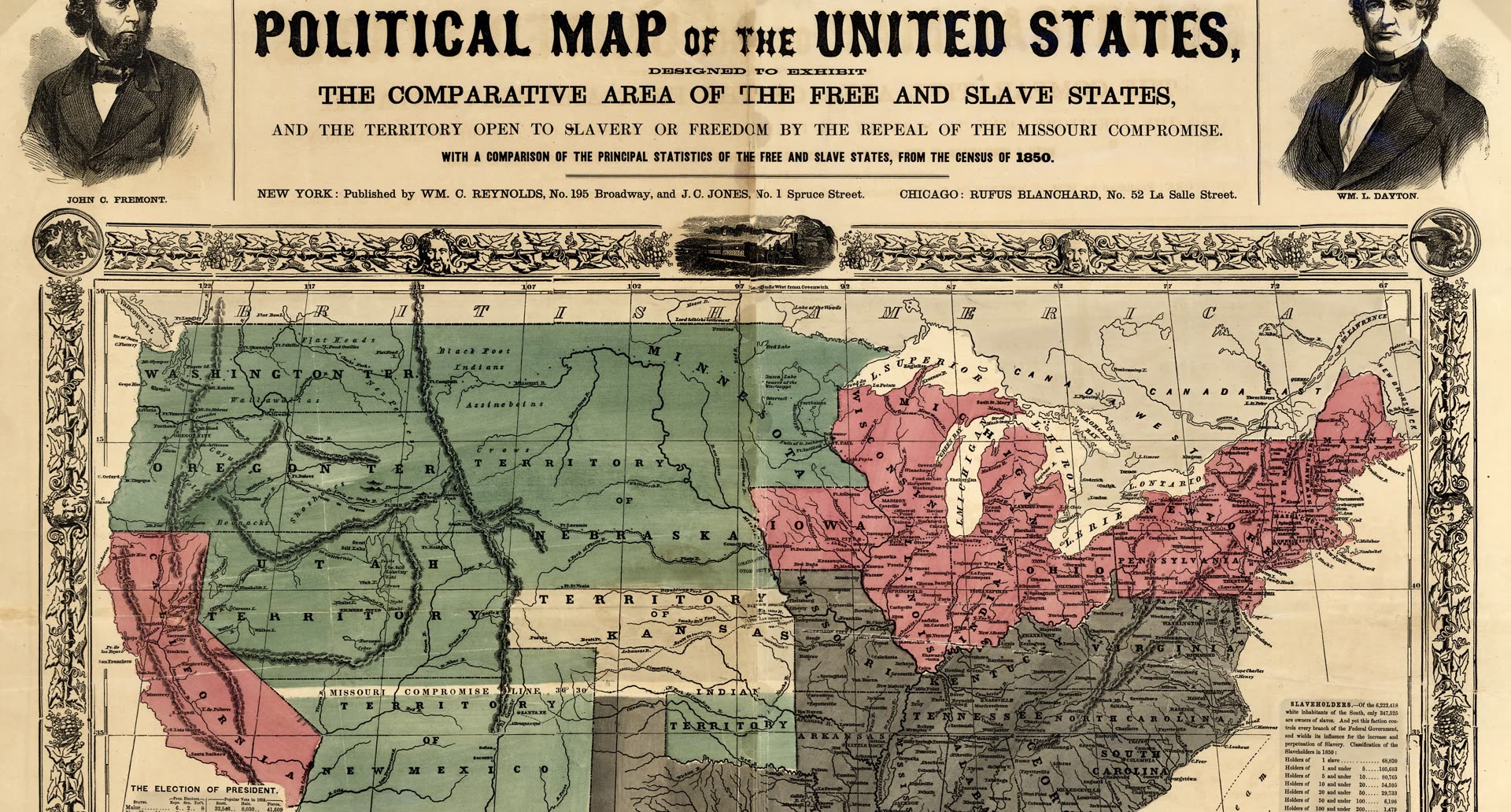
When Thomas Jefferson acquired the Louisiana Territory from France in 1803. The western frontier of the fledgling nation was quickly expanding. The addition of more states had the potential of unbalancing the number of delegates each state had in the Senate, and as such, was critical when it came to the rights of the states as well as their economic needs. For the South, this meant admitting states as slave states that had ties to the rest of the South. For the North it was a matter of pressure from abolitionists and initially to protect the fragile balance between themselves and rapid discontentment of the South. The Missouri Compromise was exactly that, a compromise to unfortunately forestall the inevitable clash between anti-slavery and pro-slavery leaders. What it did, however, was brought a temporary peace, quite similar to what the Founding Fathers did by not abandoning slavery outright.[24]
The Missouri Compromise brought a faux sense of peace by setting an actual standard for the expansion of slavery. This peace ended when the Kansas and Nebraska Territories were vying for statehood. Once again, the political balance was being upset and what erupted could arguably be considered the actual beginning of the Civil War. The Kansas-Nebraska Act was passed in Congress on May 30, 1854 by Illinois Senator Stephen Douglass, and it introduced the idea of popular sovereignty, where the people of these territories would decide for themselves as to their role as a slave or free state. Northerners were outraged as this act in all but words repealed the Missouri Compromise which they felt to be a binding agreement.[25]
The South were concerned that they would lose both Kansas and Nebraska and thereby lose for more senatorial votes in addition to the ones the North gained with the admittance of California in to the Union as a free state.[26] Nebraska was uncontested as it was just assumed it would become a free state per the Missouri Compromise, Kansas, however, was a different story. Northerners, abolitionists, Southerners and Missourians all flocked to Kansas to stack the votes in their favor. Violence erupted on both sides, and murder, deceit, political parlaying, and most of all, hatred, were every day occurrences along the Kansas and Missouri border.
The events in the west so affected the nation, that even in Congress, violence erupted. When Senator Charles Sumner of Massachusetts and an abolitionist, vociferously delivered a speech on what he considered to be the crimes against Kansas and singled out the South Carolina Senator Andrew Pickens Butler as in league with the harlot slavery, the chamber ignited with the cries that Sumner had provoked them enough to kick him as we would a dog.[27] Two days later, Butler's second-cousin Senator Preston Brooks, also of South Carolina, beat Sumner almost to death with a cane while other Congressmen just looked on.
Dred Scott was a slave who argued for his freedom first at the state level and eventually all the way to the U.S. Supreme Court. Scott lost his case on the grounds that the
plea denies the right of the plaintiff to sue in a court of the United States, for the reasons therein stated. If the question raised by it is legally before us, and the court should be of opinion that the facts stated in it disqualify the plaintiff from becoming a citizen, in the sense in which that word is used in the Constitution of the United States, then the judgment of the Circuit Court is erroneous, and must be reversed.[28]
The outcome of this ruling, by a mainly Democratic Supreme Court, had reverberating implications. Politically, the South believed this to be justification for their legal rights in the Constitution to own slaves. It also opened the door, along with the Kansas-Nebraska Act, for slavery in the territories. In the North, the resolve by abolitionists only increased and it divided the Democratic party along sectional lines, allowing the Republicans a strengthened position. David M. Potter explains in regards to the political events and attitudes of society of the 1850's that they offered a telling demonstration that the attitudes of various groups in a society toward upholding the law is in direct proportion to their approval or disapproval of the law which is to be upheld.[29]
The final straw came when Republican Abraham Lincoln was elected President in 1860. Southerners believed that Lincoln's election meant the end of their way of life as they knew it and rather than submit to Northern control, as this comment in the Atlanta Confederacy newspaper claims, they would rather
Let the consequences be what they may - whether the Potomac is crimsoned in human gore, and Pennsylvania Avenue is paved ten fathoms deep with mangled bodies, or whether the last vestige of human liberty is swept from the face of the American continent, the South will never submit to such humiliation and degradation as the inauguration of Abraham Lincoln.[30]
Personal liberty laws being passed in various northern states, while not directly associated with Lincoln's inauguration, began to come alive across the North and to the ire of an already agitated South, use these laws as justification for secession. Men such as Robert Toombs of Georgia, a leading secessionist, declared that these laws were a direct violation to the Constitution and one step closer to the annihilation of the South and a major cause for the impending disunion feelings across the southern sympathizing states.[31] With the fate of Kansas still unresolved and civil war looming on the horizon, the people of the entire nation were in the midst of picking sides for a war they could never have imagined.
Sources
[1] Coleman Younger, Story of Cole Younger: By Himself, (St. Paul: Minnesota Historical Society Press, 2000), 4-5.
[2] Ibid., 16.
[3] Andrew Borsa, "Divided Families: The Shriver Brothers of Union Mill." Crossroads of War, accessed December 1, 2015, crossroadsofwar.org.
[4] Ibid.
[5] Many books have been written about the divisions present in American leading up to the war as well as during the war, such as James M. McPherson's For Cause & Comrades: Why Men Fought in the Civil War, David M. Potters The Impending Crisis: America Before the Civil War 1848 - 1861, and Paul Calore's The Causes of the Civil War: The Political, Cultural, Economic and Territorial Disputes Between North and South are to name but a few.
[6] Or as author and historian Michael Fellman stated in his book Inside War: The Guerrilla Conflict in Missouri during the American Civil War, the war of ten thousand nasty incidents (251)
[7] James M. McPherson "The Differences between the Antebellum North and South," In Major Problems in the Civil War and Reconstruction, by Michael Perman, (Boston: Houghton Mifflin Company, 1998), 24.
[8] Paul Calore, The Causes of the Civil War: The Political, Cultural, Economic and Territorial Disputes Between North and South, (Jefferson: McFarland & Company, Inc., 2008), Kindle Edition.
[9] Ibid.
[10] United States Congress, "The Fugitive Slave Act of 1793," In The Constitution of the United States, with Acts of Congress, Relating to Slavery: Including the Nebraska and Kansas Bill, by D.M. Dewey, (Rochester: D.M. Dewey, 1854), 16-17.
[11] Norman L. Rosenberg, "Personal Liberty Laws and Sectional Crisis: 1850-1861," Civil War History 17 (1971), 26.
[12] William C. Davis, The Civil War: Brother Against Brother - The War Begins, (Alexandria: Time-Life Books, 1983), 40.
[13] Ibid., 62.
[14] David M. Potter, The Impending Crisis 1848-1861, (New York: Harper Perennial, 1976), 21.
[15] Albert Castel, Civil War Kansas: Reaping the Whirlwind, (Lawrence: University Press of Kansas, 1997), 3.
[16] Charles River Editors, Secession: The Formation of the Confederate States of America and the Start of the Civil War, (Seattle: Amazon Digital Services, Inc., 2012), Chapter 3.
[17] Ibid.
[18] Roger L. Ransom, "The Economics of the Civil War." Economic History Association, accessed December 1, 2015, eh.net.
[19] Gene Kizer Jr., Slavery Was Not the Cause of the War Between the States: The Irrefutable Argument, (Charleston: Charleston Anthenaeum Press, 2015), chapter 3.
[20] Ransom, The Economics of the Civil War.
[21] Mark W. Geiger, "Indebtedness and the Origins of Guerrilla Violence in Civil War Missouri," Journal of Southern History, 2009, 8.
[22] Ibid., 10.
[23] Lee Benson and Cushing Strout, "Causation and the American Civil War. Two Appraisals," History and Theory 1 (1961), 179.
[24] Potter, The Impending Crisis 1848-1861, 56.
[25] Paul Calore, The Causes of the Civil War: The Political, Cultural, Economic and Territorial Disputes Between North and South, (Jefferson: McFarland & Company, Inc., 2008), chapter 14.
[26] Donald L. Gilmore, Civil War on the Missouri-Kansas Border, (Gretna: Pelican Publishing Company, 2008), 6.
[27] Jay Monaghan, Civil War on the Western Border 1854-1865, (Lincoln: University of Nebraska Press, 1955), 55.
[28] FindLaw, Dred Scott v. Sandford, accessed November 5, 2015, caselaw.findlaw.com.
[29] Potter, The Impending Crisis 1848-1861, 296.
[30] Davis, The Civil War: Brother Against Brother, 116.
[31] Rosenberg, Personal Liberty Laws and Sectional Crisis 1850-1860, 40.